

I’m currently in Berlin for Theatertreffen – you can read my review of Jaz Woodcock-Stewart’s The Glass Menagerie here – but a couple of weeks ago I was in Riga, which was apparently in the grip of a second micro-winter. It was very chilly, so I spent a lot of time café-hopping and drinking cocktails laced with sorrel (unexpectedly delicious). I was there to see Łukasz Twarkowski’s Oracle at the Dailes Theatre and was fortunate enough to get to talk to him about the show the morning after what proved to be a memorable performance as you will see below.
Here’s the tedious transactional part. This newsletter takes time to research and write. Paid subscribers help to support my work while also allowing me to keep this Substack largely paywall-free, though there will be (very, very) occasional paid subscriber bonus posts, like this one on Robert Icke’s Manhunt. I currently (still) have just shy of 100 paid subscribers. If you’d like to join their number you can do so for £5 a month or £50 a year. Or just share this newsletter with someone you think might find it interesting. That helps too.
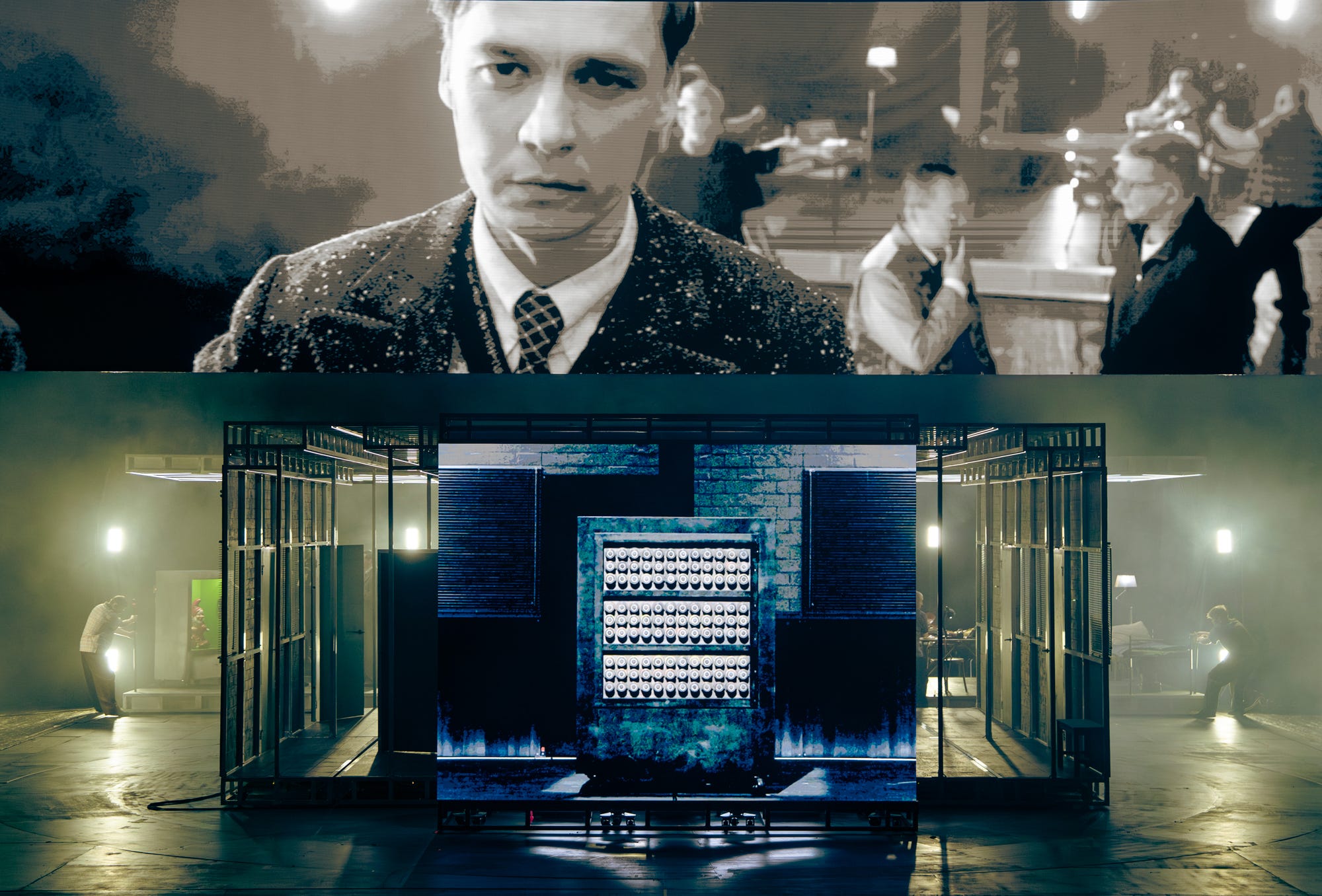
Capable of seating over 1000 people, the main hall of Riga’s Dailes Theatre is ideal for staging works of scale. Oracle, the second part of a trilogy of pieces by Łukasz Twarkowski exploring both the paradigm-shifting scientific discoveries of the 20th century and the limits of human understanding, very much fits this description. Running to almost four hours, it is a big production on both a thematic and technical level, mixing cinematic visuals, pulsing music, thermal and infrared camerawork and, what I can only describe, as a techno séance.
Initially Twarkowski had wanted to adapt Benjamin Labatut’s When We Cease to Understand the World - a novel about the scientists whose discoveries shaped our world -for the stage but was unable to get the rights. “Apparently they sold it already to Hollywood, and they’re doing a movie,” he says. So instead of adapting the book, he and his collaborators decided to create something more loosely inspired by its themes. From very early on, it became apparent they had more material than could be contained in just one performance. This needed to be a trilogy.
The first part, Quanta, which premiered at the Lithuanian National Drama Theatre in Vilnius in 2024, is set in the Les Moires Hotel in the Swiss Alps in the 1930s. With a text by Joanna Bednarczyk, who also created the text for his earlier show Respublika, it is a piece not just about quantum physics - German physicist Werner Heisenberg is a key figure – but also about the idea that there are some things we can’t know. This is a running theme in Oracle too, and arguably the guiding principle behind the whole trilogy. (Here’s an interview with Twarkowski and Bednarczyk discussing Quanta and a short video where you get some sense of the scale of the piece). The third instalment will feature Watson and Crick and the discovery of the human genome, while Oracle focuses on Alan Turing and the men and women who cracked the Enigma code.
Together the three pieces will span a period from the eve of the Second World War to the Cold War of the 1950s. The shadow of war looms large in Oracle. Twarkowski began working on the trilogy in 2023, a year into Russia’s full-scale war with Ukraine began and the proximity of the conflict, and anxiety about potential escalation, was an influence. The work is “connected with our internal fear of war at this moment,” he says.
Oracle is a typically sprawling piece. As well as Turing and his fellow Bletchley cryptanalysts, the show features a tapestry of other characters including Hedy Lamarr, the Hollywood icon, who in addition to providing the inspiration for Disney’s Snow White, co-invented a communication system which basically paved the way for Wi-Fi. The show also features the medium Helen Duncan, who in 1941, became the last person to ever be imprisoned under the Witchcraft Act in the UK after Duncan claimed to have conjured the spirit of a sailor who had died when the HMS Barham was sunk. The sinking had not yet been announced to the public and the authorities feared she somehow had access to military secrets. (She had already been investigated by the famous psychical researcher Harry Price for her claims to emit ‘ectoplasm’ during seances – there’s a fascinating account of this here). Also in the mix is Blake Lemoine, the Google engineer who suggested that the company’s LaMDA AI had become sentient. Time is porous, allowing these characters to interact.
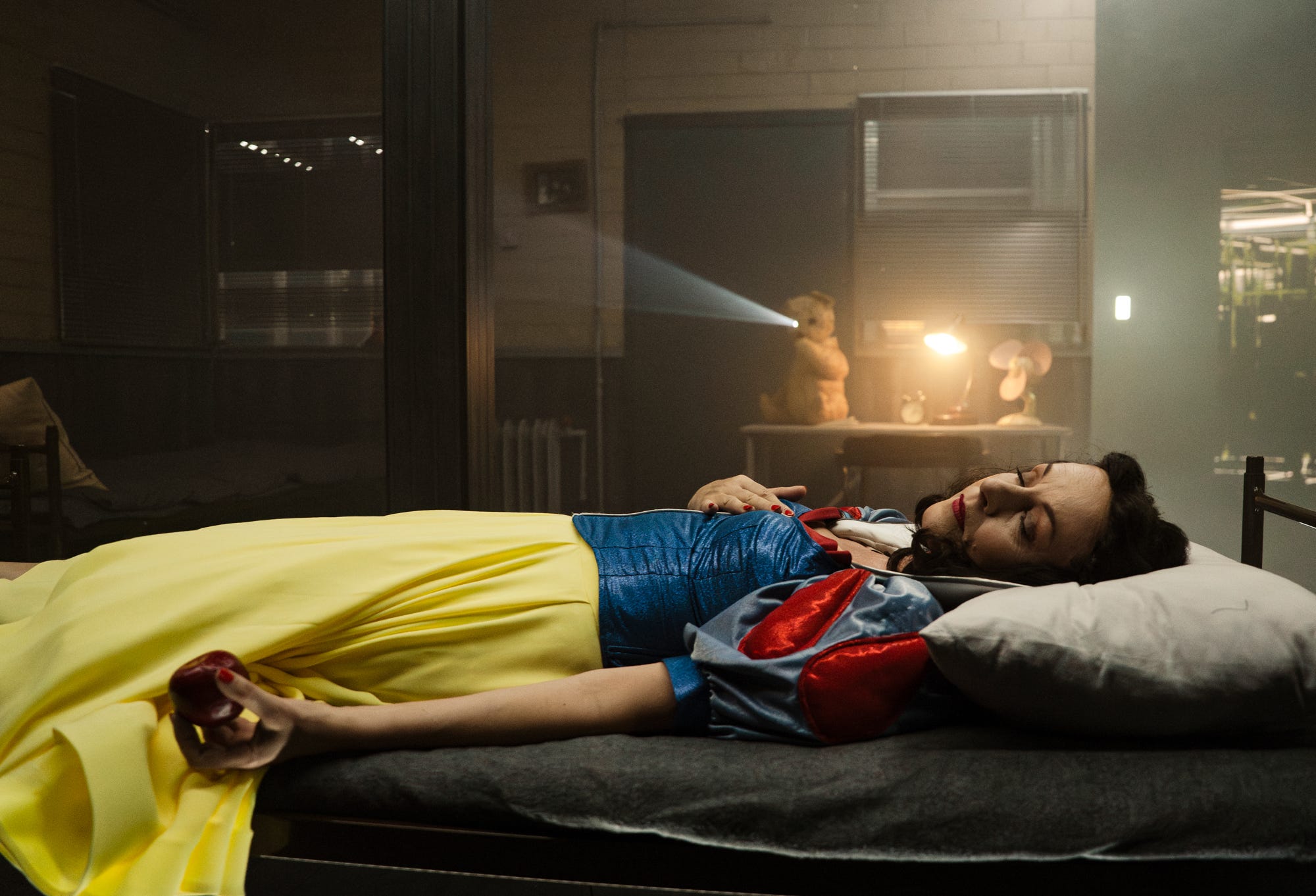
The development of the piece was a collective process, with many of the actors and creatives bringing their own research and interests to the table. (It was, for example, costume designer Svenja Gassen who introduced the fact that Hedy Lamarr was the inspiration for the animated Snow White – the image of her drifting round in costume clutching an apple takes on a different resonance if you know of Turing’s fate). The process, Twarkowski explains, takes around half a year. They begin with five weeks of laboratory work and improvisations, the results of which are used to generate a script, written in this instance by Anka Herbut, who also created the script for ROHTKO. Rehearsals follow, culminating with around five or six weeks of working on the piece with the finished set and all the technical equipment. Even after the premiere, they will refine and fine-tune the show. “In the case of Oracle, we’re still trying to understand how it functions and to find the quality that we want.”
Twarkowski describes this research process as “very intuitional.” There often comes a point, he says, where it feels like “we have too many topics, and they’re never going to connect – that it’ll be a mess.” And, then he says, “there is always this magical moment when, all of the sudden, everything connects.”

Twarkowski’s productions are intensely sensory experiences. Though his shows have a cinematic aspect, “we don’t use storyboards,” he says. Composer Julek Ploski was on hand during rehearsals, improvising and performing live sets, while choreographer Paweł Sakowicz worked with the performers.
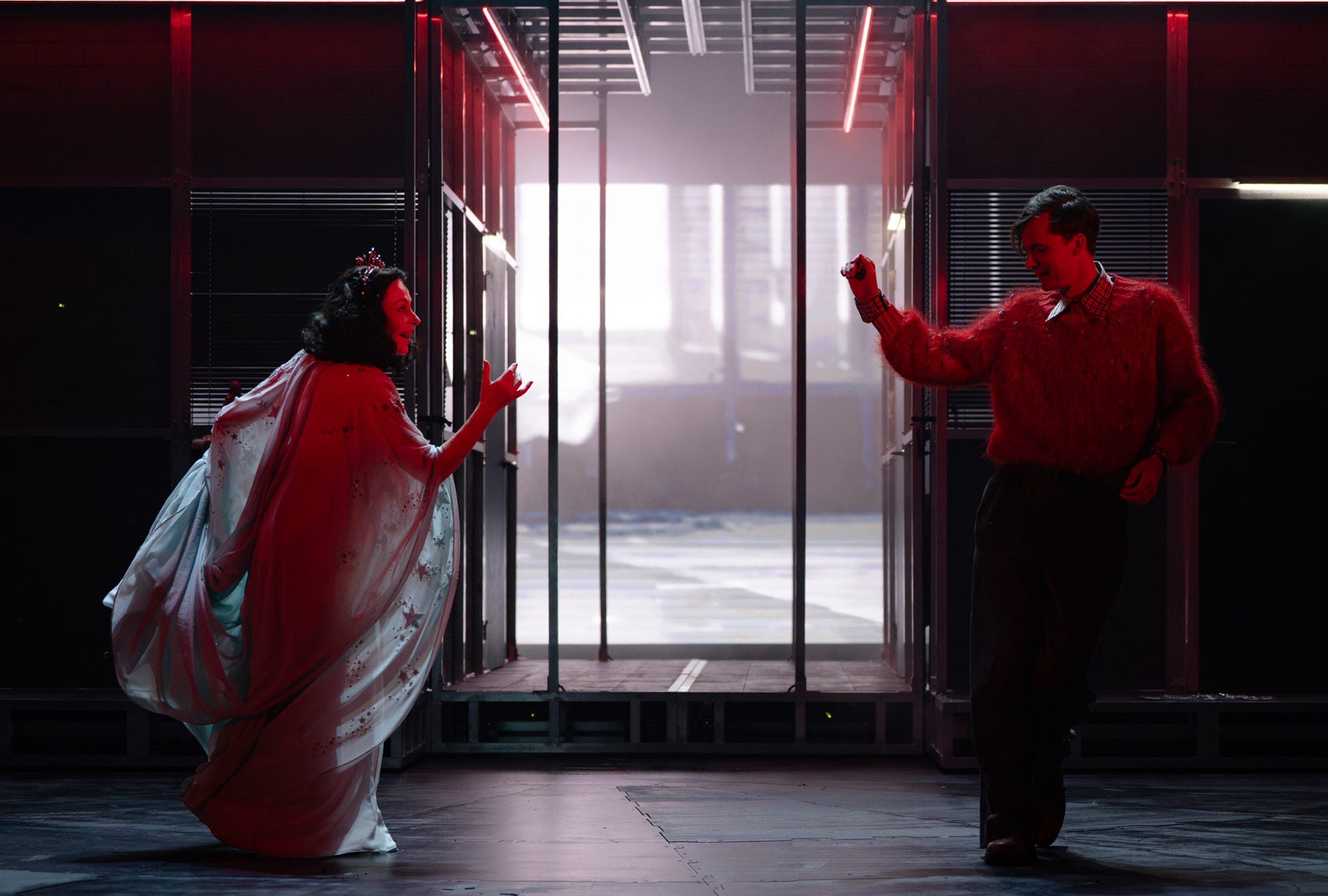
The first part takes place largely in the huts in Bletchley. The interior of Fabien Léde’s ingenious modular set is all drab brick walls and beds covered in scratchy grey blankets, everything rendered in suitably muted colours and watched over by a teddy bear with a camera for an eye. This is where Turing and his fellow codebreakers, crossword whizzes and chess masters set about deciphering German codes using the Bombe machine - the first programmable computer - but the performance is not all that interested in presenting us with a linear biography of Turing or a straightforward Second World War drama. As with ROHTKO, this is more of a meditation on various interconnecting ideas The future and the past regularly intersect. Sometimes we’re in the 1940s, sometimes we’re in the 21st century. Characters who never met in life interact. (There’s a melancholic moment of connection between Turing (Mārtiņš Meiers) and Hedy Lamarr (Vita Vārpiņa), both emotionally isolated, as they recognise something in each other. She urges him to dance and he does. It’s a delicate beat in a show that can feel overwhelming).
The Bombe machine feels almost like a character itself, filling the screen with its dials and lights. Here, as in the 2014 film The Imitation Game, Turing names the machine Christopher after a close school friend whom he had feelings for and who died young, a loss which drove his desire to better understand consciousness. “He starts dreaming about a machine which could maybe overcome the limits of human existence, the idea that there could be some sort of mind independent from the expiry date of our biological existence,” says Twarkowski.
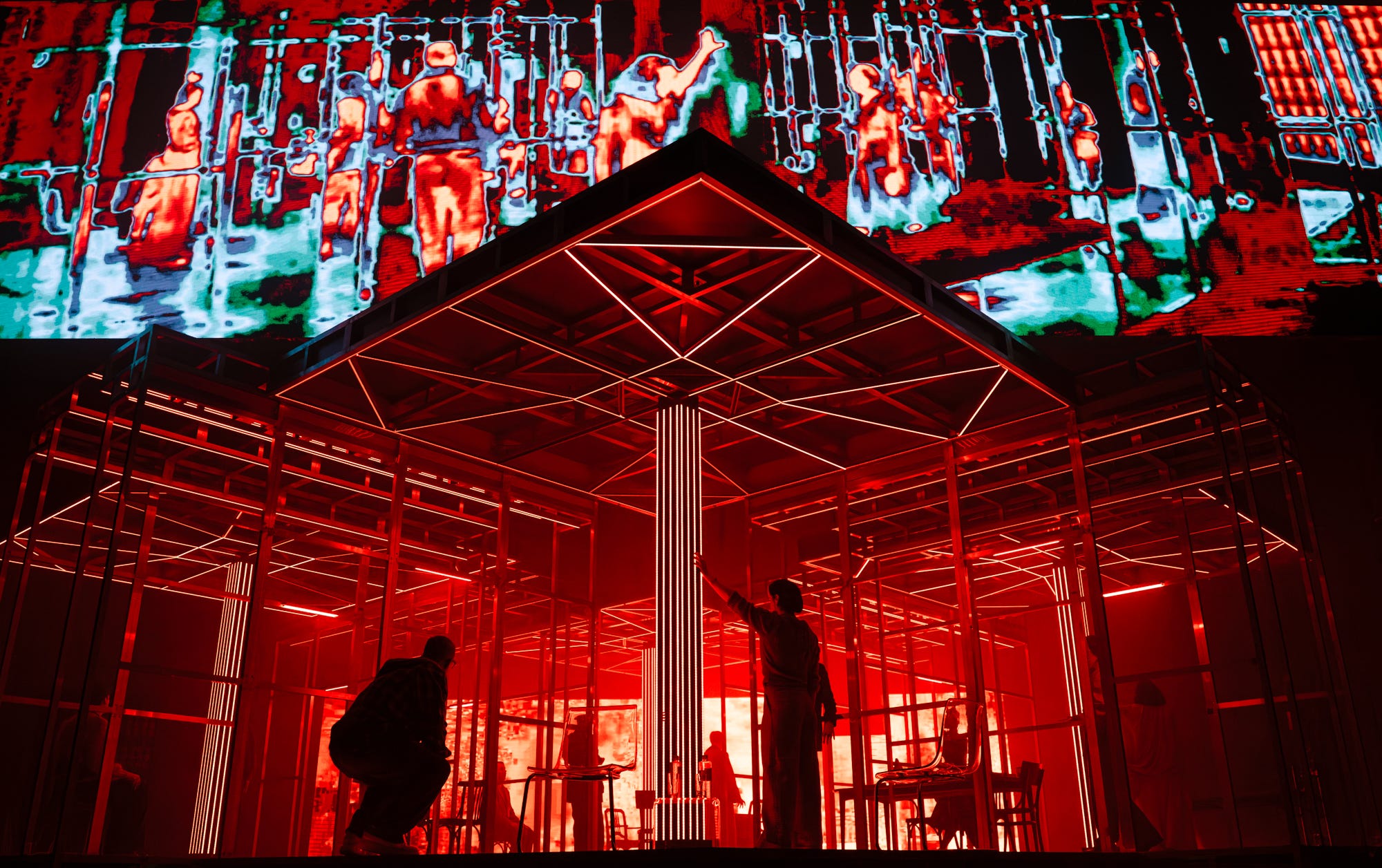
In the second half everything goes a bit Matrix-y as we pivot to a computer’s eye view of the world. “I knew from the beginning that I wanted to divide the show in two parts, which would be radically different from one another,” he says. Scenes are repeated through this digital lens, with infrared cameras used to create this disorientating shift in perspective. Bodies flame across the screens. The visuals are trippy, particularly in the séance scene when the performers’ eyes become unnerving black pools.
Oh, yes: the séance scene. The second half contains a sequence in which the characters gather, overseen by Helen Duncan, to attempt to commune with the spirits. One of their number, Ada – named for computer pioneer Ada Lovelace – becomes seemingly possessed, screaming and writhing. While the real Helen Duncan was not present at Bletchley, Doreen Valiente, a translator there, dabbled in magic and went on to become a prominent Wiccan. The character in Oracle is a kind of fusion of the two. “So we did not lie too much,” Twarkowski laughs. The séance scene emerged from the improvisation process. “I knew I wanted to connect programming with the act of foreseeing,” he says. This feeds into the deeper themes of the piece, touching on the things outside our grasp. “We used to use science and technology to simplify things and to find explanations. But then, at the beginning of the 20th century, everything collapsed with the discovery of quantum physics. We learned that reality is unforeseeable. There is a randomness to it,” he says.
On the night that I saw it, at the exact moment when they succeeded in cracking the code and Turing, triumphantly if slightly apprehensively, declared “we did it,” a technical failure occurred meaning the performance had to be stopped. After 10 minutes, they restarted the scene from the beginning, only for the electricity to fully go out at the same point. Twarkowski, speaking from the back of the theatre, encouraged us to bear with them. Finally, on the third attempt, the ghosts in the machine were exorcised and the tech behaved itself. The dialogue about patterns and repetition acquired a new ironic layer, however, as we ended up seeing the beginning moments of the second act three separate times (the actors were amazing throughout all this, though it must have been super stressful). “When you participate in these technical problems it makes a performance more unique,” Twarkowski reflects.
While a few people departed during the technical meltdown, most of the audience stayed the course. Oracle feels like an event and people didn’t want to miss it. It has, however, proved a divisive show, particularly in Riga. There have been walkouts during the second half, he says, but this was something they were aware would always be a possibility, even though he feels “we do give the audience as many tools as possible to decipher the show.”

To make work of this scale and ambition costs money. Oracle premiered in August last year at the Ruhrtriennale (here’s a selection of reviews in the German press), before opening at the Dailes Theatre last September. “It needs to be a big international collaboration. You need to have good partners,” he says. While the Dailes Theatre is the lead producer, other producing partners include Comédie de Genève, New Error, Piccolo Teatro di Milano, De Singel Antwerp, and Poland’s Adam Mickiewicz Institute. (You can read more about the Dailes’ attempt to put itself on the European theatre map in my interview with artistic director Viesturs Kairišs). Space is also a consideration. There are very few theatres that are big enough or have the requisite technical resources – including the huge LED panels – to realise a work like this. Twarkowski believes that to be able to create work of this scale and to work with the ensemble and technical crew so intensely, is only possible in Latvia and Lithuania. “That’s why this is where we made the most important works for us,” he says, “because in any country in Western Europe it would not be possible.”
Oracle is a show that embraces complexity. (It helps to have some grasp on who these people are going in, so you have something to hold on to; the programme notes help in this respect). Even the footnotes at the end of the show are not intended to tie everything up neatly, but rather to leave you with questions. At the same time, he adds, “we love to give the spectator this feeling of having discovered something.”
“The whole show is built in a way that you, as a spectator, break the code yourself,” he says. “You break the code of the performance.”
This week in European theatre
A round-up of festivals, premieres and other upcoming events over the next seven days.
Polis Festival - The 2026 edition of Ravenna’s small but ambitious international theatre festival has a Nordic focus. The line-up includes work by Camilla Parini and Laura Kutkaitė, as well as festival co-curator Agata Tomšič with her version of Heiner Muller’s Medea Material. It runs until 10 May.
Kunstenfestivaldesarts - The annual international festival of the performing arts in Brussels features work by Alice Diop, Boris Charmatz, Marlene Monteiro Freitas, Angelica Liddell and Romeo Castellucci as well as a series of late night artist talks hosted by Carolina Bianchi. It runs from 8-30 May.
Maniac – Speaking of Benjamín Labatut, his 2023 novel, inspired by the life and work of Hungarian polymath John von Neumann, a pioneer of artificial intelligence, has been adapted for the stage by Spanish director Calixto Bieito. It has its world premiere at Schauspielhaus Zurich on 8 May.
Thanks for reading! If you have any feedback, tips, or thoughts about this newsletter, you can reach me on natasha.tripney@gmail.com